 mappy
Cornell notes vs mind maps: one lecture, two formats
The short answer
Should I use Cornell notes or a mind map for lectures?
Use Cornell notes when you want a sequential record with questions you can test yourself on. Use a mind map when you need to see how concepts connect. You can also capture the lecture in Cornell form, then map one difficult relationship afterward.
Jump to the editable example download ↓
Choose the job before choosing the format
During a lecture, you need to keep up. Afterward, you need to understand what the ideas have to do with each other. One page does not have to perform both jobs equally well.
Cornell's Learning Strategies Center presents Cornell notes as one strategy to try, not a universal answer for every class. Its review routine uses questions and concealed notes to prompt explanations from memory. The page layout separates a cue column, a main notes column, and a summary.
A mind map organizes material spatially around a central idea. That can make a relationship easier to inspect, but drawing branches is not automatically a memory test. You still need to explain the content without looking. Here is one small lecture example in both formats so you can judge the difference.
The Cornell version: questions beside the explanation
Our hypothetical introductory-economics lecture is about opportunity cost. The definition follows OpenStax's discussion of choice and opportunity cost; the study-session example is original. It simplifies a decision for teaching, not financial or career advice.
| Cues / questions | Notes |
|---|---|
| What does opportunity cost mean? | The value of the next-best alternative forgone. |
| Why is there a choice? | Only two hours are available. They cannot be spent on both a study session and a paid shift. |
| What is given up by studying? | If a two-hour shift at CHF 20/hour is the next-best alternative, forgone earnings are CHF 40. This simplified example ignores taxes and other costs. |
| Why not add every rejected option? | The definition uses the next-best alternative, not the sum of every activity you could have chosen. |
| Summary | Scarcity creates choices. Identify the best alternative actually forgone and state the assumptions behind the comparison. |
The cues are written after the explanation is captured. To review, hide the right column and answer the left. If “opportunity cost” only produces a memorized phrase, use the two-hour example to explain what is actually being given up.
The mind-map version: make the relationship visible
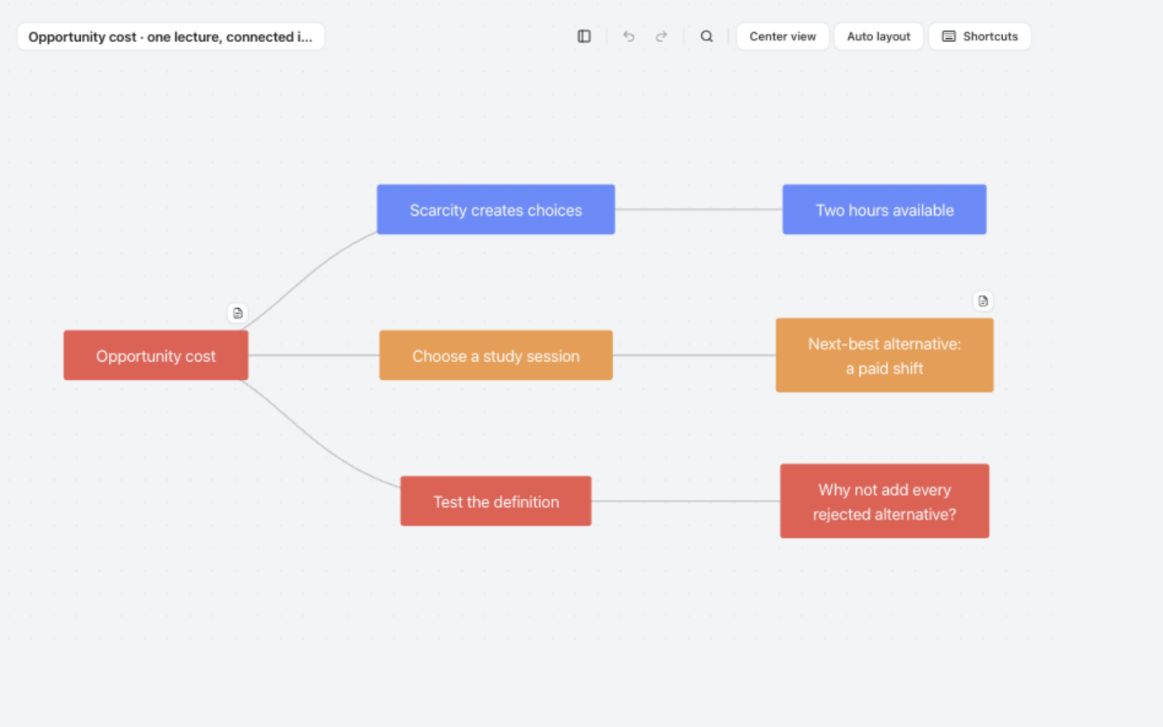
Put “Opportunity cost” at the center. One branch explains scarcity, another shows the study-versus-shift choice, and a third asks why every rejected option should not be added together. The same material is now grouped by its role in the explanation rather than by the order it arrived in class.
In the Mappy example below, the note on “Next-best alternative: a paid shift” holds the CHF 40 calculation and its assumptions. The root note holds the summary. Short labels keep the map readable; the notes preserve qualifications that would be lost in a two-word branch.
The lines show a hierarchy of ideas, not a quantified causal model. Do not read extra evidence into a connection simply because the diagram looks convincing. The text worksheet and editable map at the end of the guide contain the same example.
Where each approach gets in the way
| Your task | Try first | Watch for |
|---|---|---|
| Capture a fast, sequential explanation | Cornell notes | Write cues afterward if making them during class slows you down. |
| Compare relationships across several lessons | A mind map | Keep source references so rearranging ideas does not erase where they came from. |
| Follow a detailed derivation | Linear working or an expanded note | A branch diagram is usually too small for every intermediate step. |
| Prepare for questions | Either, with answers hidden | Looking at familiar notes is not the same as producing an explanation. |
If mapping during class makes you miss the lecturer's qualifications, stop arranging the canvas and capture plain notes. If a Cornell page becomes a list of isolated definitions, map the one relationship you cannot yet explain. Keep what solves the problem; there is no need to turn every lecture into two polished documents.
A hybrid routine without rewriting the whole lecture
- Capture: record the lecture in a linear notes column, including examples and source references.
- Question: add three or four cues that test an explanation, not only a vocabulary word.
- Connect: choose one confusing relationship and map it. For opportunity cost, that is scarcity → choice → next-best alternative.
- Retrieve: close both versions. Explain a new example and state the assumptions.
- Repair: compare your answer with the course source, then correct the specific mistake.
This is a suggested workflow, not a measured claim that a particular format produces higher grades. The useful output is an explanation you can check. A more attractive map is not enough on its own.
For a fuller practice routine, use the blank-page recall guide. For organizing a whole lecture, see the lecture-notes walkthrough.
Do you need Mappy for this?
No. You can make Cornell notes on paper or in a text editor, and draw a mind map by hand. The text worksheet is available without signup or purchase. Mappy is useful if you want connected ideas and longer notes together on your Mac, with editable local documents and no subscription.
The .mindmap download is an original example for Mappy, not an import file for every mind-mapping app. Mappy's full editor requires a one-time in-app unlock; its onboarding preview does not include unrestricted editing of your own files. Downloading the worksheet or sample does not grant that unlock.
Import the sample if you already use Mappy, or use the screenshot to build the same structure in your preferred tool. Replace the example with an actual lecture and keep the source details. The method is more important than the software.
Original example · no signup
Download the opportunity-cost mind map
Download the editable map (.mindmap)
In Mappy, open Settings → Storage → Import and select this file. It contains the example shown here, including its expanded notes. Importing creates a library copy, so keep your downloaded original for reuse.
The file is free to download. Editing it in Mappy requires the one-time Full Unlock purchase; the app's onboarding preview does not unlock your own documents. This is a Mappy document, not a universal mind-map format. Prefer plain text? Use the worksheet below.
Cornell notes worksheet: opportunity cost
Use this outline in any notes editor, or recreate its branches in Mappy. It is a plain-text worksheet, not an automatically importable .mindmap file. No signup is needed for the template.
Download the text template (.txt)
Topic: Opportunity cost
Source: Your lecture, textbook chapter, or course handout

CUE: What is opportunity cost?
NOTES: The value of the next-best alternative forgone.

CUE: Why do we have to choose?
NOTES: Time is scarce. In this hypothetical example, two hours
cannot be used for both a study session and a paid shift.

CUE: What is given up by studying?
NOTES: Assume a two-hour shift at CHF 20/hour is the next-best
alternative. Forgone earnings: CHF 40. Ignore taxes and other
costs for this simplified exercise. Other benefits may matter.

CUE: Why not add every rejected option?
NOTES: Opportunity cost refers to the next-best alternative,
not the total of all possible activities you did not choose.

SUMMARY: Scarcity creates choices. Identify the best alternative
actually forgone, and state the assumptions in the comparison.

REVIEW: Hide the notes and answer the four cue questions.
Then explain a different example without copying these sentences.
Correction to make / source page:
Next question to ask in class:
A guide from Mappy's creator. Examples are illustrative, not research findings or claims of improved grades. How these guides are written.