 mappy
Turn lecture notes into a usable mind map
The short answer
How do I take lecture notes with a mind map?
Capture the main ideas as short branches, keep examples and explanations in longer notes, and revise the structure after class. Do not try to transcribe every sentence into a node.
Before the lecture: leave space for surprises
Make the center specific: “Ecology, week 4: nutrient enrichment” tells you more than “Lecture notes.” Add a few branches from the outline if one is available, plus an “Open questions” branch. Treat this as a temporary structure, not a prediction of everything the lecturer will say.
Keep the reading title or lecture reference in the main node's notes. If you return to the map six weeks later, you should still know where the material came from.
During the lecture: separate claims from examples
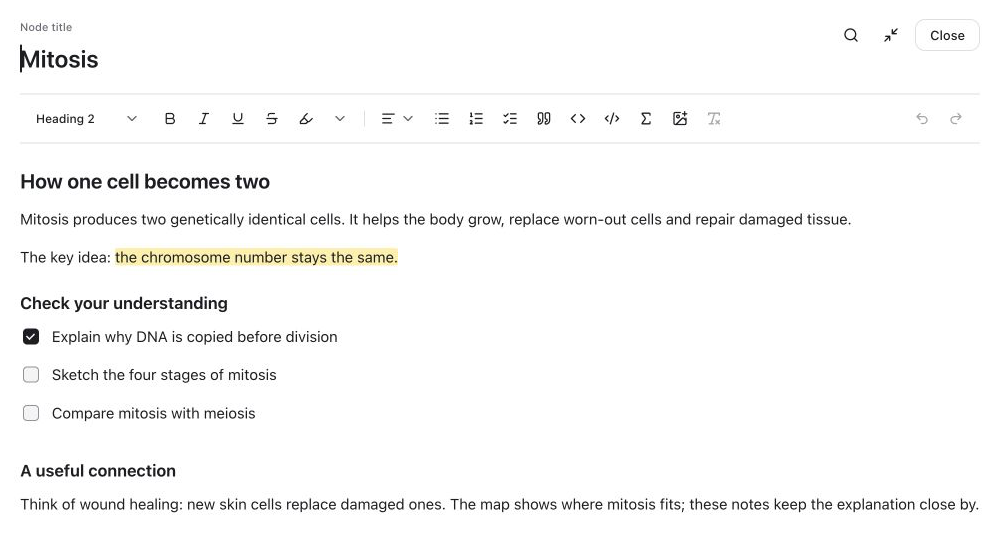
Use a short node for the claim and a child for a concrete example. Put the explanation in expanded notes when it becomes too long for a label. A node called “Nutrient inputs” might have children for agricultural runoff and wastewater, with qualifications written underneath in the notes.
Mark uncertainty explicitly. “Check whether this applies to shallow lakes” is a useful note. A confidently written but incomplete explanation is much harder to repair because you may not remember that you were unsure.
In Mappy, Tab creates a child and Enter creates a sibling when a node is selected outside text editing. While actively writing a paragraph, use the normal text-editing behavior instead. Practice those two map commands before class so the software does not compete with listening.
After class: spend ten minutes restructuring
- Rename vague labels so each says one recognizable idea.
- Move examples under the claims they actually support.
- Add the missing steps in explanations while you remember them.
- Attach page numbers or links for claims you need to verify.
- Turn unresolved points into specific questions for the next seminar.
If the lecture was a sequential proof or a detailed derivation, ordinary linear notes may be the better first capture format. You can build a map afterward to organize assumptions, results, and applications. You do not have to force every subject into the same shape.
Make the map ask something of you
At your next review, look at the branch names and explain each idea without reading its expanded note. Then check what you missed. Use the gaps to choose a practice problem or a question for class, rather than merely making the diagram prettier.
A map is an organizational aid, not evidence that you understand the topic. The useful test is whether you can explain a connection and use it in a new example. Keep the course material as your authority when an abbreviated map leaves out an important qualification.
A guide from Mappy's creator. Examples are illustrative, not research findings or claims of improved grades. How these guides are written.