 mappy
Literature review mind map: from papers to themes
The short answer
How do I make a literature review mind map?
Put your research question at the center, use themes as branches, and place source-backed claims under each theme. Record methods, limitations, and page references in the notes. Use the map to compare papers, not just to list their titles.
Jump to the editable example download ↓
Start with a question narrow enough to compare
You have three paper summaries, but still no paragraph. The missing step is often comparison: what do the papers measure differently, and which claim can each actually support? A literature review mind map is useful when it makes that comparison visible.
“Urban nature” is too open-ended. “How do studies of university students measure green-space exposure and attention?” gives you a population, an exposure, and an outcome to inspect. Our original example below follows that question. It uses fictional studies so you can practice the structure without mistaking invented citations for evidence.
Williams College Libraries describes concept mapping as a way to connect ideas while developing a research question and reviewing literature. This guide's example is our own, not a university-endorsed template.
Put the exact question in the center and write exclusions in its notes. Here, exclude school-age children and studies measuring only property prices. Boundaries prevent an interesting but irrelevant paper from quietly changing the project.
Build themes, not an author-by-author filing cabinet
Start with three provisional branches: “How exposure is measured,” “How attention is measured,” and “What could explain differences.” Put a source under the claim it supports. The same source can inform more than one branch; use a consistent short identifier so you do not mistake repeated references for independent evidence.
Keep the full reference in your citation manager or bibliography. A mind map is the reasoning layer, not the authoritative record of every PDF. A source link in Mappy does not automatically format a bibliography or synchronize a Zotero library.
For each claim, record the relevant method, sample, result, and limitation in expanded notes. Include a page or figure reference. That small discipline lets you return to the actual passage when your draft needs a precise qualification.
Worked example: explain a disagreement
Imagine three fictional papers. These are placeholders for practicing synthesis, not research findings:
- Study A: surveys students once about perceived greenery and perceived concentration.
- Study B: compares attention-task scores before and after a supervised walk.
- Study C: measures distance from residences to green space but does not record whether students visit it.
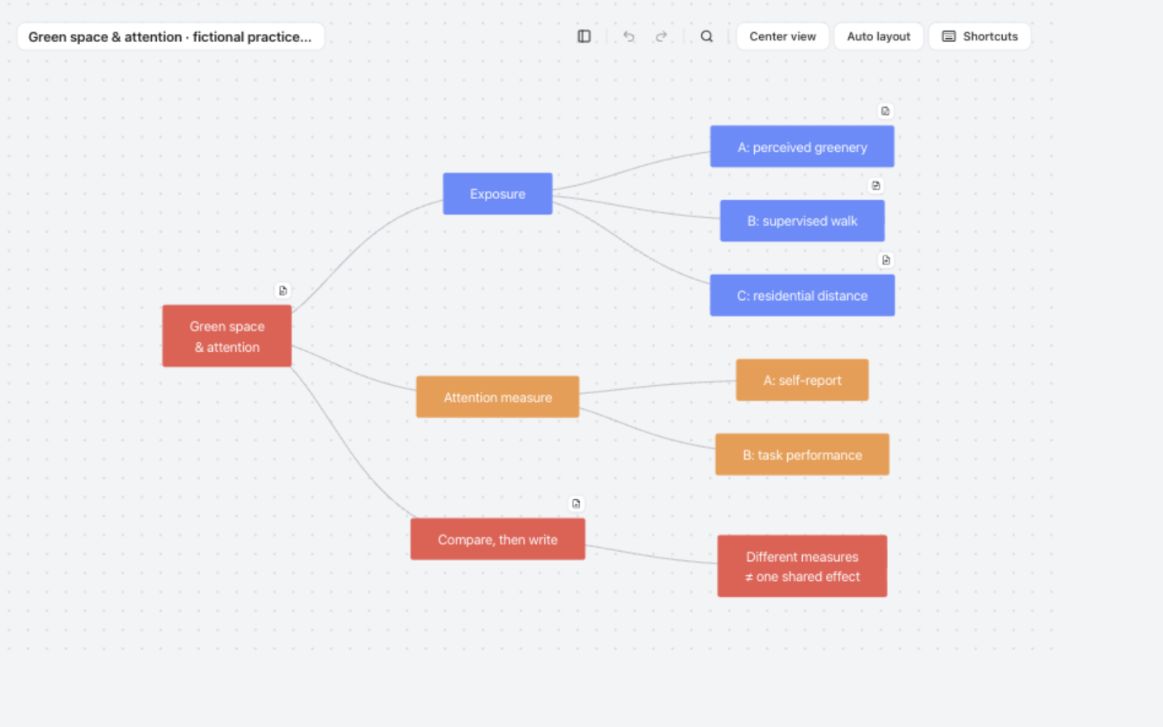
A title-based map gives you three summaries. A theme-based map reveals that the papers do not measure the same exposure or outcome. Put A and C under “Everyday exposure,” B under “Short-term activity,” and all three under the relevant measurement notes.
A cautious synthesis sentence could be: “These studies approach different questions: perceived surroundings, short-term activity, and residential proximity should not be treated as interchangeable measures.” You can write that comparison without inventing a shared effect or calling one method universally better.
Now add a question: which source would actually support the claim in your proposed paragraph? If none does, mark the evidence gap instead of filling it with an assumption.
Turn one branch into one paragraph
Choose a theme and draft four sentences: the point being compared, the evidence from relevant sources, the reason their findings or designs differ, and the implication for your question. Then inspect whether every sentence is supported by the papers you attached.
Do not label something “a research gap” just because it is absent from the papers you have read. Write “not found in my current source set,” keep a search log, and check the wider literature. A systematic review also needs a documented search and selection method; this map does not replace one.
Use the single-paper notes template when a source is still confusing. Use the argument outline once you know what the section should claim.
Open the example and replace one source at a time
The screenshot shows the same ten-node document provided in the download. Blue branches compare exposure measures, orange branches compare attention measures, and the red synthesis branch records what you can safely conclude. Open the note on “B: supervised walk”: it asks you to check the comparison condition and practice effects before interpreting a before-and-after change.
- Download the .mindmap file below and import it into Mappy with Full Unlock. Keep the original as a reusable example.
- Replace the central question and its scope note with your actual topic.
- Replace A, B, and C with real source identifiers. Do not retain fictional studies in an assessed literature review.
- For each source, add the full citation or a consistent reference-manager key, method, finding, limitation, and exact page or figure.
- Rewrite the synthesis only after you have checked those sources. Delete branches that your evidence does not support.
Not using Mappy? The text worksheet below contains the same planning fields. You can use it without an app purchase or signup. Neither version includes real research findings, a reference database, or automated citation formatting.
Keep the map readable as the review grows
Stop adding branches when the map no longer helps you compare. Split a large review into one overview and separate theme maps, with clear names such as “Attention review: measurement.” Keep rejected or out-of-scope sources in a separate record so they do not crowd the argument.
Mappy suits the personal planning part of this workflow: short nodes for themes, longer notes for evidence, links to sources, and local files on your Mac. It has no subscription and no Mappy account. It is not a citation manager or a shared systematic-review screening system.
At the end of a reading session, leave one explicit next action: find a missing comparison, check a page reference, or draft a paragraph. A useful map should make the next reading decision easier, even before the literature review is finished.
Original example · no signup
Download the worked literature-review map
Download the editable map (.mindmap)
In Mappy, open Settings → Storage → Import and select this file. It contains the example shown here, including its expanded notes. Importing creates a library copy, so keep your downloaded original for reuse.
The file is free to download. Editing it in Mappy requires the one-time Full Unlock purchase; the app's onboarding preview does not unlock your own documents. This is a Mappy document, not a universal mind-map format. Prefer plain text? Use the worksheet below.
Literature review planning template
Use this outline in any notes editor, or recreate its branches in Mappy. It is a plain-text worksheet, not an automatically importable .mindmap file. No signup is needed for the template.
Download the text template (.txt)
Research question:
Scope: population / setting / period / exclusions

Theme or contested claim:
  Source ID and full citation:
  What this source actually supports:
  Method, sample, and setting:
  Exact page, table, or figure:
  Limitation relevant to this claim:
  Agrees or disagrees with:
  Possible reason for the difference:

Synthesis sentence:
Evidence still needed:
Search terms for the next reading session:
Next paragraph to draft:
A guide from Mappy's creator. Examples are illustrative, not research findings or claims of improved grades. How these guides are written.